Key takeaways
- Dealers typically handle title, registration paperwork, trade-ins, and the payoff of any loan on your trade.
- You can use financing arranged by the dealer or bring your own estimate. Comparing both on the same terms is what matters.
- Trade-in equity is the trade-in value minus what you still owe on it. Only the equity reduces the amount financed.
- Read the buyer's order line by line and confirm the amount financed matches what you agreed.
What a dealer typically handles
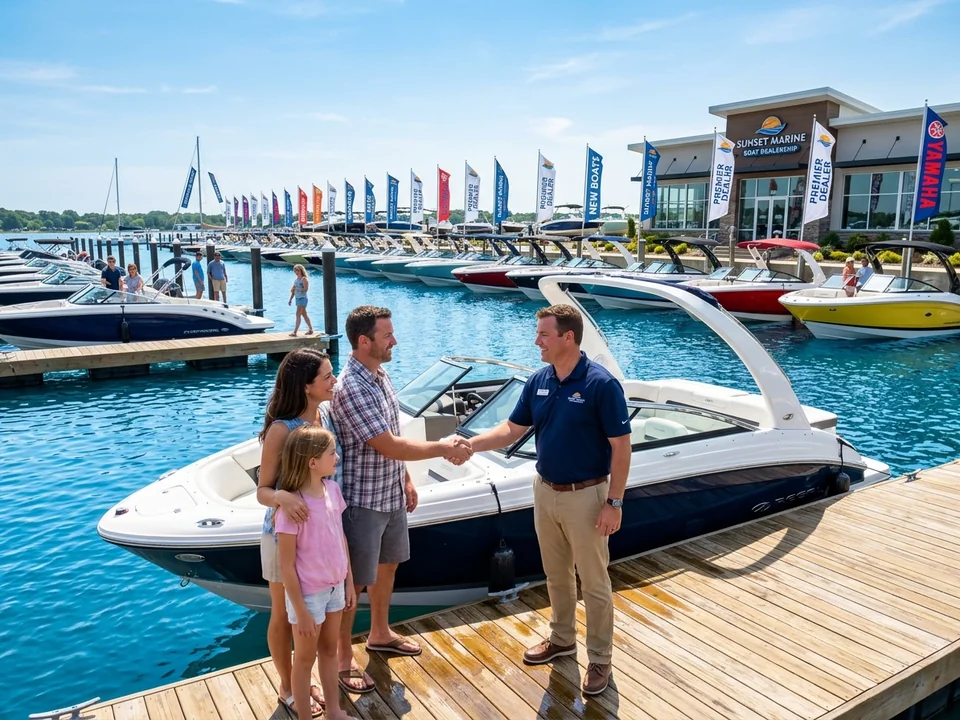
A dealer sells new boats and often used boats, usually from an inventory on site. Beyond the sale itself, a dealership commonly takes care of:
- Paperwork: the buyer's order, bill of sale, manufacturer's certificate of origin for new boats, and transfer documents.
- Title and registration: submitting title and registration applications to the state, or providing what you need to do so, and collecting the related taxes and fees where the state allows.
- Trade-ins: appraising your current boat, and paying off any loan on it as part of the deal.
- Rigging and delivery: installing electronics and accessories, commissioning the engine, and orienting you on the boat at delivery.
- Service and warranty: warranty work and scheduled maintenance, if the dealer has a service department.
What is included varies by dealership, so ask which of these services are part of the price and which carry separate fees.
How trade-ins affect the numbers
A trade-in is valued by the dealer, and that value is applied to the new purchase. If you still owe money on the trade, the dealer typically pays that loan off, and only the difference, your equity, reduces the amount financed. If you owe more than the trade is worth, the shortfall may be added to the new loan, which increases the amount financed.
An illustrative example using standard amortization:
| Scenario | Amount financed | Monthly payment | Total interest |
|---|---|---|---|
| No trade-in | $43,000 | $411 | $30,967 |
| Trade valued at $10,000 with a $4,000 payoff ($6,000 equity) | $37,000 | $354 | $26,646 |
Ask for the trade-in value and the price of the new boat as separate numbers. Seeing them separately makes it easier to compare the trade offer with what you might get selling privately, and to compare one dealer's full offer with another's. You can include a trade-in in the advanced inputs of the boat payment calculator.
Dealer-arranged financing vs bringing your own estimate
Many dealers can arrange financing by submitting your application to one or more lenders they work with. This can keep the purchase and the loan in one place and may give you access to manufacturer or lender programs. You can also arrive with your own numbers, or financing you have arranged separately, and ask the dealer to work with it.
Neither approach is right for everyone. What helps is knowing your own estimate before you sit down: the price range you are comfortable with, the down payment you plan to make, an estimated APR range and the term you are considering. With that baseline, you can compare any offer on five numbers:
- Amount financed
- APR
- Term in months
- Monthly payment
- Total of payments, or total interest
A lower monthly payment can come from a longer term rather than a lower rate, so look at all five together. Some lenders, including Vantage, may offer terms up to 240 months depending on the loan. The loan term calculator shows how term changes both the payment and the total interest.
Know your numbers before the finance officeEstimate the payment for your price, down payment, trade-in and term.
Open Boat Payment CalculatorQuestions to ask the dealer
- Is this price for the boat, engine and trailer together, and what options are included?
- What do the freight, prep and documentation fees cover?
- How was my trade-in valued, and what payoff amount are you using?
- Which add-ons on this order are optional, and what does each cost?
- What is the APR, term and total of payments for this financing offer?
- Is there a prepayment penalty if I pay the loan off early?
- When will the boat be delivered, and is a water delivery or orientation included?
- Who handles warranty claims and service after the sale?
Read the buyer's order line by line
The buyer's order (also called a purchase agreement or bill of sale, depending on the dealer) is the document that sets out exactly what you are buying and what you are paying. Before you sign, check that:
- the year, make, model, HIN and engine serial numbers match the boat you inspected;
- the selling price matches the price you agreed, before fees;
- each fee is listed and explained, with no duplicate or unfamiliar charges;
- optional products are only the ones you chose;
- the trade-in value and payoff are shown as agreed;
- taxes are calculated on the correct amount for your state;
- the cash down and amount financed match the loan documents.
If anything is unclear, ask for it to be corrected or explained in writing before signing. It is reasonable to take a copy home and review it.
Sales tax, registration and titling rules differ by state. For questions about your obligations, consult a qualified tax or legal professional, or your state's boating or revenue agency.
Frequently asked questions
Generally, yes. Dealers commonly work with outside lenders. Let the dealer know early so they can provide the purchase documents your lender will need.
The difference, often called negative equity, may be paid in cash or, where the lender allows, added to the new loan. Adding it increases the amount financed, the monthly payment and the total interest.
Many dealers submit title and registration paperwork as part of the sale, but practices vary by dealer and state. Ask who files the paperwork and when you can expect to receive registration numbers and documents.